Digital twins of brain organoids could transform computational neuroscience, neuromorphic computing, and artificial intelligence.
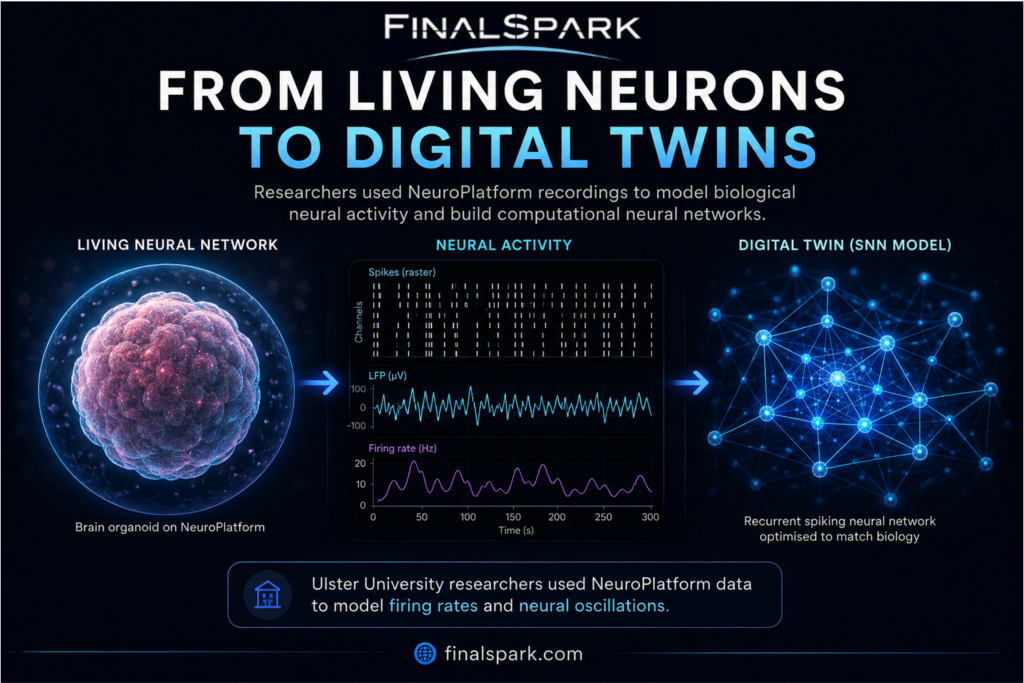
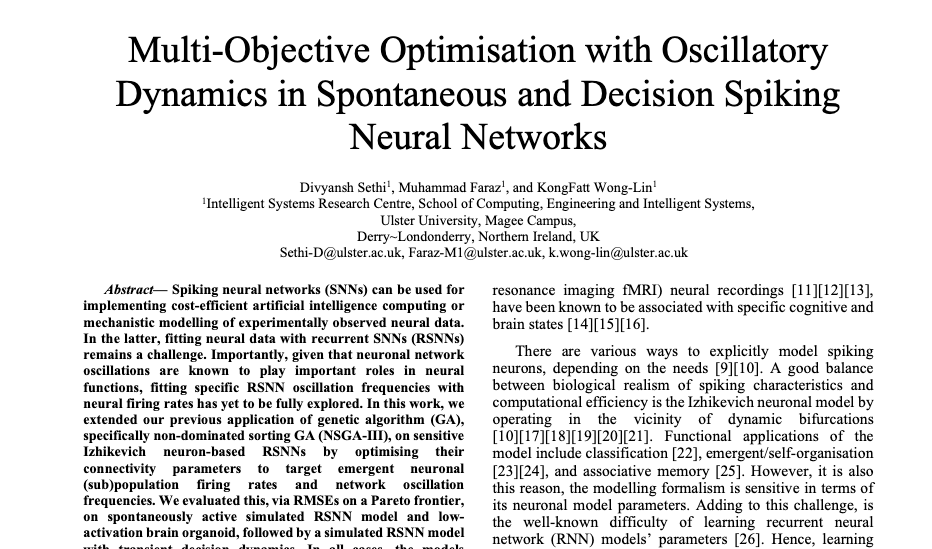
Researchers at Ulster University recently explored this possibility using data recorded on the FinalSpark Neuroplatform. The study, led by Professor KongFatt Wong-Lin, demonstrates how electrophysiological recordings from living brain organoids can be used to build computational models that reproduce biological firing rates and neural oscillations.
The work represents an important step toward creating digital twins of brain organoids for computational neuroscience, neuromorphic computing, and next-generation AI research.
What are digital twins?
A digital twin is a computational model that reproduces the behaviour of a real-world system. Digital twins are already widely used in aerospace, manufacturing, healthcare, and industrial optimisation, allowing researchers and engineers to simulate, analyse, and predict the behaviour of complex systems.
Applying this concept to living neural networks could provide a powerful new tool for understanding biological computation. Researchers could use digital twins to test hypotheses, investigate neural dynamics, explore new computational paradigms, and accelerate the development of biologically inspired computing systems.
In the context of organoid computing, digital twins of brain organoids could allow researchers to compare biological and computational systems, test hypotheses more efficiently, and better understand the mechanisms underlying biological information processing.
As interest in organoid computing continues to grow, digital twinning may become an important bridge between experimental biology and computational modelling.
How researchers used FinalSpark Neuroplatform data
In their recent study, researchers from Ulster University used electrophysiological recordings obtained from the FinalSpark Neuroplatform.
The data originated from living brain organoids cultured on multielectrode arrays and remotely accessible through the Neuroplatform. The researchers analysed neural firing activity and used these recordings as biological targets for computational models based on recurrent spiking neural networks.
Using multi-objective genetic optimisation techniques, the team developed models capable of reproducing key characteristics of the biological recordings, including neuronal firing rates and neural oscillations.
Importantly, the authors describe this work as a potential foundation for future digital twinning approaches in organoid computing, helping researchers better understand the neural circuit mechanisms that underlie biological computation.
The researchers effectively used Neuroplatform recordings as a biological reference for building digital twins of brain organoids, demonstrating how living neural activity can guide the development of computational neural models.
Why this matters
This work highlights a growing role for Neuroplatform beyond wetware computing experiments.
Researchers can use Neuroplatform data to:
- Validate computational neural models
- Study biological computation
- Develop neuromorphic algorithms
- Investigate biologically inspired AI systems
- Explore neural oscillations and network dynamics
- Build digital twins of brain organoids
Access to real biological neural activity provides a unique opportunity to ground computational models in experimentally observed behaviour rather than purely theoretical assumptions.
This study represents an important step toward creating digital twins of brain organoids based on real biological recordings rather than purely theoretical assumptions.
As organoid computing evolves, the ability to compare computational models against living neural systems may become increasingly valuable for both neuroscience and artificial intelligence research.
Applications of digital twins of brain organoids
Digital twins of brain organoids could support computational neuroscience, neuromorphic computing, AI development, neural circuit modelling, and biologically inspired computing. By combining real biological recordings with computational models, researchers can explore how living neural networks process information, adapt to stimuli, and generate emergent behaviours.
As organoid computing continues to evolve, digital twins of brain organoids may become valuable tools for understanding biological intelligence and developing future computing architectures.
Bridging biology and computation
One of the most exciting aspects of this study is that it demonstrates a new way of connecting biological and computational intelligence.
Rather than viewing biological neural networks and artificial systems as separate domains, the researchers used real biological recordings as a reference point for model development and optimisation. This creates opportunities for closer integration between experimental neuroscience, neuromorphic computing, and machine learning.
Such approaches may ultimately help researchers better understand how biological neural systems process information while inspiring new computational architectures that leverage principles found in nature.
Looking ahead
We are excited to see Neuroplatform contributing to research at the intersection of neuroscience, artificial intelligence, computational modelling, and digital twinning.
This work demonstrates how data obtained from living neural networks can support not only wetware computing experiments, but also computational neuroscience, neuromorphic engineering, and the development of biologically grounded AI systems.
The ability to create digital twins of brain organoids may help bridge experimental neuroscience and computational modelling, opening new opportunities for biologically grounded artificial intelligence research.
Congratulations to Professor KongFatt Wong-Lin and colleagues at Ulster University on this work.
Interested in working with living neural networks?
Explore the FinalSpark Neuroplatform and gain remote access to living neurons for research in organoid computing, computational neuroscience, neuromorphic computing, and next-generation artificial intelligence.